
Who Really Profits When Wegovy Runs Through 340B?

How 340B Reshapes Wegovy Prices.
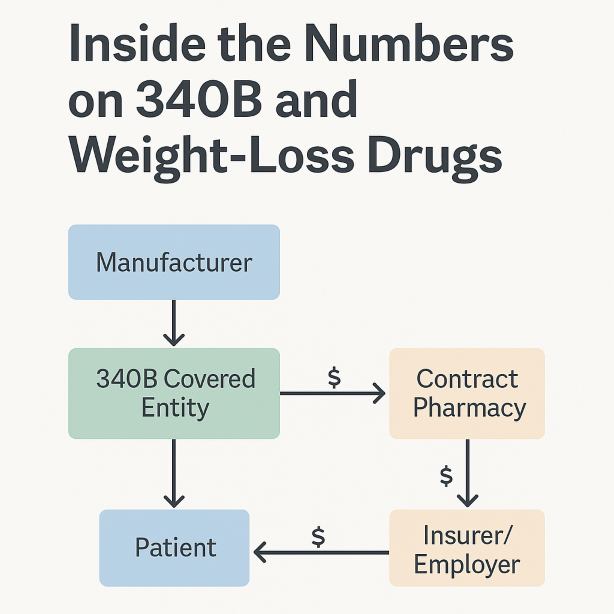
A patient finally gets their Wegovy prescription approved. They show up at a national chain pharmacy, brace for the copay, and are told it’s out of stock. A week later, they try again at a different pharmacy—this one is a “contract pharmacy” for a big nonprofit hospital. Wegovy is magically available.
Same dose. Same insurer. Same month.
The copay might look familiar, but the explanation of benefits reads like a tax return. What the insurer paid, what the pharmacy was reimbursed, what the manufacturer actually got, and what the hospital earned from the transaction don’t match any one “price” you see in the news.
A big reason: the 340B Drug Pricing Program, which sits quietly between the list price and the money changing hands.
This is a "follow‑the‑money" explainer for Wegovy under 340B—and what happens when it doesn’t run through 340B at all.
What 340B Actually Is (in normal English)
The 340B Drug Pricing Program is a federal discount program run by the Health Resources and Services Administration (HRSA). Drug makers that want Medicaid coverage must sell many outpatient drugs at steep discounts to certain “safety‑net” providers.
Those providers, also called “covered entities”, include:
Public and nonprofit hospitals that treat a high share of low‑income patients (disproportionate share hospitals, cancer hospitals, children’s hospitals)
Federally Qualified Health Centers (FQHCs)
Ryan White HIV/AIDS clinics and other federal grantees
The official purpose, straight from HRSA and GAO: let these providers “stretch scarce federal resources to reach more eligible patients and provide more comprehensive services.”
Behind the scenes:
Manufacturers must offer a confidential 340B “ceiling price”—the maximum price they can charge a covered entity.
That ceiling price is based on Average Manufacturer Price (AMP) and Medicaid rebate formulas; details are mathy, but the outcome is simple:
HRSA itself estimates 340B discounts at about 20–50% off the cost of the drug.
Hospitals and clinics then bill insurers (and patients) normal commercial rates, keep the spread between reimbursement and 340B acquisition cost, and say they use that margin to fund charity care, free vaccines, behavioral health services, and so on.
To reach patients who never set foot inside the hospital, covered entities can sign up contract pharmacies—regular retail pharmacies that dispense the drug on the hospital’s behalf under 340B rules. HRSA has formal guidance on how this works.
You’ll notice something missing in that description: no requirement that the 340B discount show up at the pharmacy counter as a lower copay.
Wegovy’s Sticker Shock, Before Any Discounts
Wegovy is semaglutide, the same active ingredient class as Ozempic, but FDA‑approved specifically for chronic weight management.
Several independent and manufacturer‑linked sources put Wegovy’s list price—also called Wholesale Acquisition Cost (WAC)—at about $1,349.02 for a 28‑day pack of four pens.
We’ll call that $1,350 per month to keep the arithmetic sane.
Crucial nuance:
List price / WAC is what the manufacturer charges wholesalers before rebates and discounts.
“Wegovy costs $1,349 a month” is therefore technically true and practically misleading. Most people pay something very different.
Two other price realities:
For people without coverage, Novo Nordisk and partners now advertise cash prices like $499/month (earlier) and, as of late 2025, $349/month, with promos as low as $199/month for starter doses, through NovoCare and affiliated channels.
For Medicare, new negotiated prices under the Inflation Reduction Act will drop semaglutide products to around $274 per month in 2027, according to recent federal announcements and news reporting.
Those are separate universes. Today, most working‑age people with employer insurance still live in the $1,300 WAC world, not the $274 Medicare world—and 340B works off that high list‑price architecture.
Scenario 1: Wegovy at a Regular Retail Pharmacy (No 340B)
Let’s start with the “plain vanilla” version: no 340B involved.
A commercially insured patient fills Wegovy at a standard retail pharmacy that has no 340B relationship with a hospital or clinic.
We’ll label what’s based on real data and what’s a modeling choice.
The starting price
Fact: Wegovy list price ≈ $1,349.02 per 28‑day supply. We’ll round to $1,350.
How the benefit works:
Assume:
Wegovy sits on a “specialty” tier with 30% coinsurance.
The allowed amount (what the plan is willing to pay for the drug itself) is the full $1,350.
So:
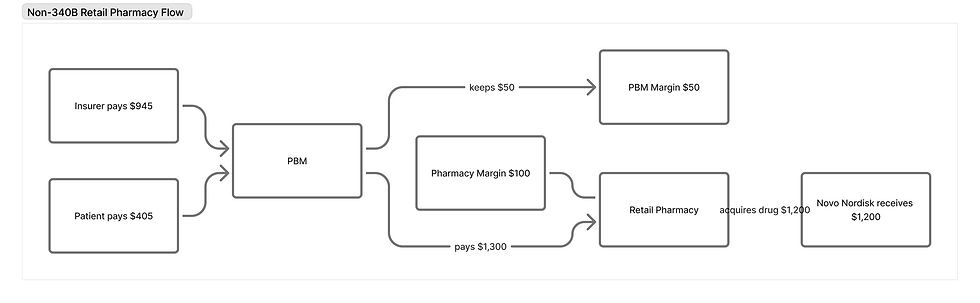
Patient pays: 30% of $1,350 = $405
Insurer/employer pays: 70% of $1,350 = $945
Total dollars leaving patient + plan: $1,350.
What the pharmacy and PBM see:
Now the plumbing:
Assumption: The pharmacy’s effective acquisition cost for Wegovy is $1,200 (reflecting typical distributor discounts off WAC).
The PBM reimburses the pharmacy $1,300 for the claim.
The PBM bills the plan/patient $1,350, keeping $50 as spread—the difference between what it charges the plan and what it pays the pharmacy.
So, per monthly script:
Manufacturer revenue (before rebates): about $1,200
Pharmacy margin: $1,300 – $1,200 = $100
PBM margin on the claim: $50
We’re deliberately not layering in manufacturer rebates here; in reality, PBMs often receive separate rebates that reduce the manufacturer’s net revenue and the plan’s net cost. For GLP‑1s, those rebates are becoming quite large, according to recent Medicare negotiations and investor reporting.
Total paid in by patient + plan: $1,350.
Total distributed among manufacturer, pharmacy, PBM: $1,200 + $100 + $50 = $1,350.
So far, no 340B. Just ordinary brand‑drug economics.
Scenario 2: Wegovy at a 340B Contract Pharmacy
Now, same patient, same insurer, same Wegovy dose. The only difference is where the prescription is filled.
This time, the patient uses a contract pharmacy that dispenses drugs on behalf of a nearby 340B‑eligible hospital. The claim is coded so it can be “captured” as a 340B outpatient prescription.
On the payer side, nothing changes. On the back end, everything does.
The 340B price:
HRSA and GAO say 340B discounts typically run 20–50% off the cost of the drug.
We’ll pick:
Assumption: Wegovy 340B discount = 30% off WAC
340B acquisition price: $1,350 × (1 − 0.30) = $945
So the 340B hospital can buy that month’s Wegovy for about $945, not $1,350.
What the plan and patient see:
We hold the benefit design constant:
Allowed amount: still $1,350
Patient coinsurance (30%): $405
Insurer/employer payment (70%): $945
Total to the PBM: $1,350—just like the non‑340B case.
How the 340B contract pharmacy flow works:
Under HRSA’s 340B contract pharmacy guidance, the hospital “owns” the 340B drug; the pharmacy dispenses; and the two settle up behind the scenes.
Assume this pattern:
PBM keeps the same $50 spread.
PBM pays the contract pharmacy $1,300.
The pharmacy keeps $80 as a fee for dispensing, inventory management, etc.
The pharmacy passes the remaining $1,220 back to the 340B hospital.
The hospital pays the manufacturer $945 (the 340B price) and pockets the difference.
That difference is the hospital’s 340B margin:
$1,220 – $945 = $275 per month per Wegovy prescription

Again:
Patient + plan pay $1,350.
Manufacturer + PBM + pharmacy + hospital together receive $1,350.
Manufacturer: $945
Pharmacy: $80
PBM: $50
Hospital: $275
Nothing in the benefit design forces anyone to lower the patient’s copay just because 340B was used.
What this means for patients: In this stylized example, the patient still pays $405 in both pharmacies. The insurer still pays $945. The only thing that changes is who keeps the money once it leaves your wallet: the non‑340B world sends more to Novo Nordisk and the pharmacy; the 340B world moves about $275 per month onto the hospital’s balance sheet.
Side‑by‑Side: Wegovy With and Without 340B
Now put both scenarios next to each other.
Table – Wegovy non‑340B vs 340B (per monthly prescription)
Metric | Non‑340B retail pharmacy | 340B contract pharmacy |
Wegovy list price (WAC) | $1,350 | $1,350 |
Assumed acquisition price | $1,200 (pharmacy) | $945 (340B hospital) |
Patient out‑of‑pocket | $405 | $405 |
Insurer/employer payment | $945 | $945 |
Manufacturer revenue (before rebates) | $1,200 | $945 |
Pharmacy margin | $100 | $80 |
PBM margin (spread) | $50 | $50 |
340B hospital margin | $0 | $275 |
Key observation:
Patient: pays the same $405 either way.
Insurer: pays the same $945 in both cases.
Manufacturer: goes from $1,200 to $945 (−$255).
340B hospital + pharmacy: go from $100 margin to $355 combined margin (+$255).
In other words, the 340B arrangement moves roughly $255 per month per Wegovy script from Novo Nordisk’s column to the hospital/pharmacy column, without touching the patient’s bill in this example.
Fact vs Guesswork (And What Could Be Different in Real Life)
Grounded in data:
Wegovy list/WAC ≈ $1,349.02 per 28‑day pack, per Novo Nordisk and multiple independent price trackers.
HRSA and GAO say 340B discounts are typically about 20–50% of the cost of the drug, i.e., 20–50% off what other buyers would pay.
HRSA and hospital groups state that 340B savings are used to “stretch scarce federal resources” and fund services like free care, vaccines, and community programs.
HRSA’s contract pharmacy guidance spells out that covered entities can use outside pharmacies to dispense 340B drugs and share revenue.
Manufacturers now offer cash prices for Wegovy as low as $349/month, with temporary promos at $199/month for starter doses, via NovoCare and partners.
Explicit assumptions in the scenarios:
We picked a 30% 340B discount off Wegovy’s WAC—well inside HRSA/GAO’s 20–50% range, but not an actual disclosed 340B price.
We set coinsurance at 30% and assumed the allowed amount equals WAC. Many plans use similar structures, but real benefit designs vary.
We used tidy round numbers for pharmacy margin and PBM spread ($100 and $50) that reflect common patterns but are not tied to any single contract.
We ignored manufacturer rebates in the math—even though, in reality, negotiated rebates for GLP‑1s under commercial and Medicare plans can dramatically reduce manufacturer net revenue and insurer net cost.
Things that could differ in the wild:
A PBM might exclude 340B claims from its rebate contract, changing manufacturer net revenue.
Some plans might base coinsurance on a lower negotiated price, reducing the patient’s dollar out‑of‑pocket.
A particular hospital or clinic might choose to pass some 340B savings directly to patients—for example, via sliding‑scale pharmacy programs or in‑house specialty pharmacies.
The story we’ve told is stylized, but the shape is consistent with what GAO, MedPAC, USC’s Schaeffer Center, and hospital advocates all describe:
340B creates a margin between acquisition cost and reimbursement, and GLP‑1s are rich territory for that margin.
Bottom Line: Who Wins, and Does Any of It Reach You?
Looking just at Wegovy:
In our non‑340B scenario, most of the $1,350 monthly price flows to Novo Nordisk and the retail pharmacy, with a small slice to the PBM.
In the 340B scenario, the patient’s copay is unchanged, the insurer’s payment is unchanged, but about $255/month per script moves from the manufacturer’s pocket to the 340B hospital + contract pharmacy.
So:
Biggest beneficiary in these Wegovy examples: the 340B hospital or clinic, which can net hundreds of dollars per prescription per month.
Moderate beneficiaries: contract pharmacies and PBMs, via fees and spreads.
Relative loser: the manufacturer, which sells Wegovy below its usual net price.
Wild card: the insurer; in our simplified math, they neither gain nor lose from 340B, though in reality, rebate structures could change that.
For the individual patient who just wants to afford Wegovy, 340B is not a guaranteed lifeline:
Nothing in the law requires the hospital to lower your copay.
Whether any of that 340B margin reaches you depends entirely on how your local system uses the money—subsidizing drugs, funding a weight‑management clinic you can access, or plugging some unrelated hole in the budget.
If you’re trying to make sense of this as a patient, two very fair questions to ask your provider or health system are:
“Are you a 340B covered entity?”
“If my Wegovy prescription runs through 340B, will any of that discount reduce what I pay, or is it used for other services?”
The honest answers will tell you more about your real‑world access than any list price—$1,349, $499, or $349—ever will.
Notes & Source URLs
Here are key sources used in this article, with direct links:
HRSA 340B program overview:https://www.hrsa.gov/opa
ASHP 340B FAQ (plain‑language explanation of program purpose and covered entities):https://www.ashp.org/-/media/assets/pharmacy-practice/resource-centers/ambulatory-care/docs/340-B-FAQ.pdf
American Hospital Association fact sheet on 340B (how hospitals say they use savings):https://www.aha.org/system/files/media/file/2025/10/fact-sheet-the-340b-drug-pricing-program-r-10-2025.pdf
HRSA Contract Pharmacy Services guidance:https://www.hrsa.gov/opa/implementation-contract
GAO / HRSA estimates that 340B discounts are about 20–50% of drug costs:
Wegovy list price (≈$1,349.02 per 28‑day supply):
Nicerx: https://www.nicerx.com/blog/wegovy-cost-without-insurance/
NovoCare list price explainer: https://www.novocare.com/obesity/products/wegovy/let-us-help/explaining-list-price.html
Drugs.com pricing overview: https://www.drugs.com/medical-answers/what-cost-wegovy-3579864/
WeightWatchers explainer: https://www.weightwatchers.com/us/blog/weight-loss/wegovy-cost
Wegovy cash/self‑pay prices ($349/month and $199 starter offers):
NovoCare savings card terms: https://www.novocare.com/eligibility/wegovy-savings-card.html
OVYVO explainer on Novo’s pricing update: https://ovyvo.com/understanding-novo-nordisks-new-wegovy-pricing-update-what-it-means-for-you/
Reuters coverage of $349 Wegovy cash price: https://www.reuters.com/business/healthcare-pharmaceuticals/novo-nordisk-rolls-out-349-wegovy-cash-price-ahead-plan-2025-11-17/
Medicare’s negotiated semaglutide prices (~$274/month starting 2027):
Financial Times: https://www.ft.com/content/46152712-53f5-4664-acdf-e545dc7ddee8 Financial Times
Investors.com summary: https://www.investors.com/news/technology/novo-nordisk-stock-ozempic-wegovy-ira-discounts/
Wall Street Journal overview: https://www.wsj.com/health/pharma/u-s-negotiates-lower-prices-for-ozempic-and-14-other-drugs-c410e72c
General 340B oversight and growth (GAO reports):
GAO‑21‑107: https://www.gao.gov/products/gao-21-107
GAO‑20‑212: https://www.gao.gov/pdf/product/703966
GAO‑18‑480: https://www.gao.gov/assets/gao-18-480.pdf


Comments