
The $15 Revolution: Did the Ozempic Wall Just Crumble?

The complexities of expired Ozempic patent and medical tourism | PoundsPunch Periodical | April 2026 Edition
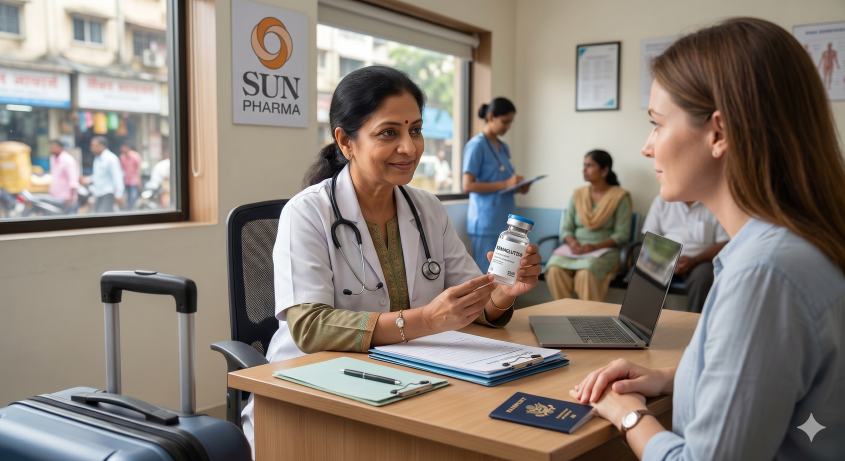
The Great Prescription Migration
Meet Sarah. She’s a schoolteacher from Cincinnati, Ohio. For years, Sarah followed her primary care physician’s advice: she tried specialized diets, joined structured exercise programs, and even failed a six-month trial of Metformin. Finally, her doctor gave her the green light for weight-loss medications. But when she reached the pharmacy counter, the "green light" hit a red wall. Her insurance denied coverage because her BMI didn't meet their specific "comorbidity" threshold. The price tag for Wegovy (Novo Nordisk)? A staggering $1,100 per month, entirely out-of-pocket.
In early April 2026, Sarah looked at her bank account and then at a flight aggregator. A round-trip ticket from Cincinnati, Ohio, to New Delhi, India, costs roughly $1,350. It is a grueling 14-hour flight, but Sarah realized that by flying to India to purchase a three-month supply of medication, she could cut her total costs—including the flight—by over 60% compared to buying it in Ohio.
The Legal Catch: Under current US FDA personal import policy, individuals can generally bring back a 90-day supply of a medication for personal use if they have a valid prescription and it is not for resale. However, Sarah’s US insurance won't touch this. Any medicine purchased outside the US is "off-formulary," meaning every cent she spends in India is a "sunk cost" that doesn’t count toward her US deductible.
While this story is hypothetical, it represents a reality that may quickly become a viable option for thousands of Americans.
The Background: What Exactly Expired?
To understand the earthquake, you have to look at the "Compound Patent." In the pharmaceutical world, patents are like layers of an onion. The core layer—the actual chemical structure of the Semaglutide molecule—is what expired in India last month.
While Novo Nordisk still holds "secondary patents" (like the design of the injection pen) in many places, India’s patent laws are famously strict about "evergreening." Once that core chemical patent hit its 20-year limit on March 20th, the floodgates opened. Over 40 Indian generic giants, including Sun Pharma and Dr. Reddy’s, were waiting with their own versions ready to ship the very next morning. That means Indian companies can bypass these secondary patents by selling the medication in a traditional vial meant for a standard syringe, rather than the proprietary "Blue Pen".
The frenzy over GLP-1s didn't happen overnight. It was a slow burn that turned into a wildfire.
Supply: All prices listed in the table reflect a 28-day (4-week) supply. For injectables, this typically consists of one carton containing four pre-filled pens or a single multi-dose pen.
Cadence: The medications are intended for once-weekly administration (one dose every seven days), as per FDA-approved labeling for chronic weight management and type 2 diabetes.
Impact: April’s "Price War" in the Streets
What has happened in the last 30 days is nothing short of a retail frenzy. Generic brands like Usema and Semanat hit the shelves at prices that look like typos to American eyes: they are being advertised at ₹1,250 (roughly $15 USD) for a 1mg dose. This is biologically equivalent to the $1,100 Wegovy (Novo Nordisk) Sarah was prescribed in Cincinnati.
What's Novo's Response? To keep their market share, Novo Nordisk officially slashed the price of branded Ozempic and Wegovy (Novo Nordisk) in India by up to 48% on April 1st, bringing the "name brand" cost down to roughly $60/month.
The Competition? Eli Lilly (Lilly) has responded by accelerating the distribution of Mounjaro (Lilly) in Southeast Asian markets, though their patent remains secure for longer, they are feeling the pressure to lower "Global Access" pricing.
In Mumbai clinics this month, the atmosphere is electric. At endocrinology centers, the shift is palpable. Dr. Nadeem Rais, a prominent Mumbai-based endocrinologist, recently reported that while he currently manages around 70 to 80 patients on active GLP-1 treatment, he expects that number to triple to over 200 almost immediately as the price barrier dissolves. The "Medical Tourism" we once saw for dental work is pivoting to the pharmacy counter.
The US Reaction: Indianapolis, IN and Beyond
In Indianapolis, IN, the headquarters of Eli Lilly (Lilly), and in the US offices of Novo Nordisk, the reaction is a mix of legal defense and innovation. US pharma giants are lobbying for stricter "quality control" messaging, warning patients that generic vials from abroad lack the rigorous safety oversight of the US supply chain.
Is the quality warning legitimate? The reaction from the American medical community is split. Many endocrinologists are cautiously welcoming the global price drop, hoping it pressures US insurers to expand coverage. However, the American Medical Association (AMA) remains on the fence, expressing deep concerns over the "wild west" nature of unmonitored medical tourism and the risks of counterfeit generics entering the US via mail.
What’s Next? The Global Domino Effect
Brazil & China (Late 2026): Keep your eyes on these two. Their patent expirations are coming up next. If China’s massive manufacturing engine starts churning out $10 Semaglutide, the US price wall may face its biggest challenge yet.
Europe: Several EU countries are currently reviewing "Compulsory Licensing," which would allow them to ignore patents in the interest of public health costs.
At the end of day, as we keep watching how all things keep evolving, we will leave you with these questions.
If a medication can be sold profitably for $15 in Mumbai, why is the "discounted" price in Manhattan still $550?
Will US doctors begin writing "International-Friendly" prescriptions for patients who simply cannot afford domestic prices?
As more generic "vial and syringe" versions become available, will the convenience of the "Blue Pen" be enough to keep patients loyal to US Big Pharma?
References
GoodRx Health (2024): A Savings Guide to GLP-1 Receptor Agonists. Detailed tracking of Wegovy (Novo Nordisk) list price increases from $1,349 to $1,430 and the evolution of manufacturer assistance programs.
National Consumers League (2025): The Truth About Medication Costs. Analysis of the "Coupon Wars" between Zepbound (Eli Lilly) and Wegovy (Novo Nordisk) that stabilized average commercial out-of-pocket costs at $550.
TIME Magazine (Historical Reference): How Vanity Sizing Made Shopping Impossible. Documentation on the shift of U.S. standardized sizing from 1958 (Size 12) to modern vanity scales (Size 6).
Livemint / Business Standard (March 21, 2026): "India’s weight-loss drug rush kicks off with generics 50-90% cheaper." Initial reporting on the launch of Semanat (Natco Pharma) and Glipiq (Glenmark) following the March 20th patent cliff.
NAVLIN Daily (March 23, 2026): "India Sees Semaglutide Prices Crash to $15 Monthly Post Patent Expiry." Comprehensive breakdown of the price war between Sun Pharma and Dr. Reddy’s, specifically highlighting the $15 entry point for vial-and-syringe formulations.
eNCA / AFP (March 21, 2026): "India to tackle global obesity with cheap fat-loss jabs." [Source for Dr. Nadeem Rais quote] Explores the capacity of Indian manufacturers to meet global demand and the expected tripling of patient volumes. https://www.enca.com/news/india-tackle-global-obesity-cheap-fat-loss-jabs
Abel + Imray (April 2026): Secondary Patents and the Pen Device Battle. A technical explanation of why Indian manufacturers can produce the Semaglutide molecule while the "Blue Pen" delivery device remains protected in the U.S. until 2032.
U.S. Food & Drug Administration (FDA): Personal Importation Program (Information on Personal Use Importation). Guidance on the 90-day supply rule for individuals traveling abroad with a valid prescription.
U.S. Customs and Border Protection (CBP): Know Before You Go: Bringing Medication into the U.S. Verification of requirements for declaring biological medications and the prohibition on resale.


Comments