
The Intelligence Mismatch: Can AI Outrun the Scale?


The Digital-Physical Paradox
Every morning, the "digital" world moves faster. In the last year, Google search queries for "AI" and "Generative Agents" have hit an estimated 150 million hits monthly, outstripping "weight loss" by a factor of nearly 50 to 1. We are obsessed with the idea that AI can solve everything—from our taxes to our code. But while our brains are in the cloud, our bodies are still here on the ground.
There is a strange irony in our closets. It is harder to find a "Size Medium" today than it was seventy years ago. In 1958, the U.S. government released its first standardized sizing chart based on 15,000 women’s measurements. Back then, a Size 12 represented a 25.5-inch waist. Today, that same 25.5-inch waist is labeled as a Size 6 or even a Size 4 in most major brands. We are physically larger, even as our clothing labels try to tell us otherwise. As the "AI Boom" promises a smarter world, we are left wondering: What is the solution when it comes to our actual weight?
The "Severe Obesity" Map: A Red Alert for the Heartland
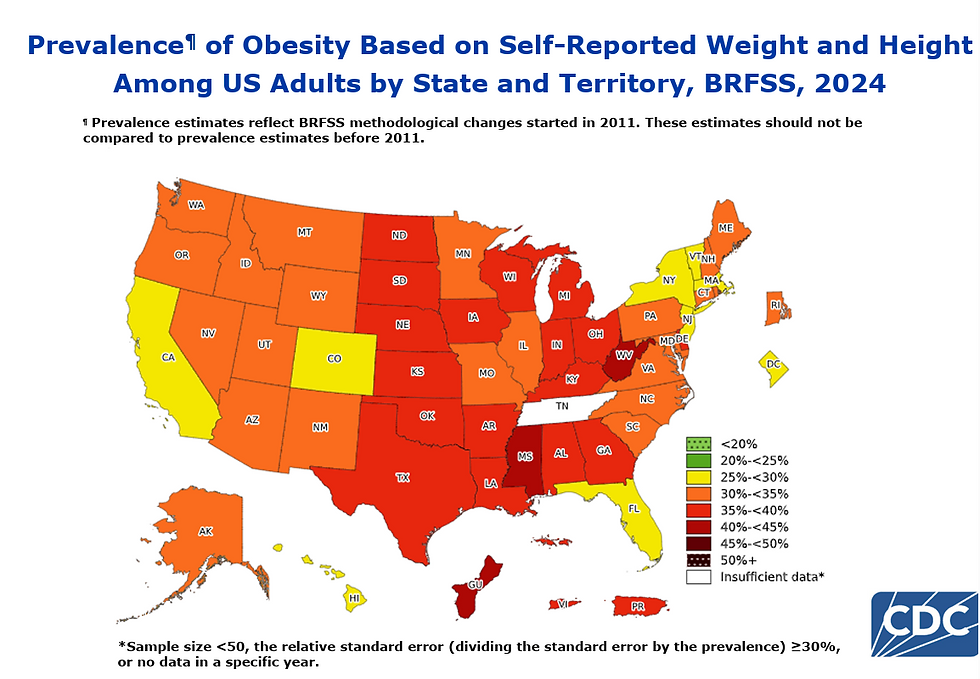
The latest CDC Adult Obesity Prevalence Maps show that we have reached a breaking point. For the first time, states like West Virginia and Mississippi have surpassed a 40% prevalence rate for adults with a BMI over 30.
What does this mean for our country?
Economically: This isn't just a health stat; it’s a workforce crisis. High-BMI states face significantly higher rates of chronic absenteeism, a "productivity tax", and healthcare expenditures that drain state-funded Medicaid budgets.
Financially: The demand for GLP-1 medications in these regions is astronomical, but so is the cost to state-funded Medicaid programs, which are struggling to keep up with the $1,000/month price tags. This data proves that the demand isn't a "fad"—it is a critical national infrastructure need.
Mentally: There is a growing "Health Divide." Despite the "AI hype" promising precision, many in these "deep red" states feel left behind by a healthcare system that still treats obesity as a moral failing rather than the chronic disease the maps prove it to be.
The paradox is clear: while the tech boom is concentrated on the coasts, but the clinical need is thousands of miles away. It is the ultimate mismatch: Silicon Valley Brain, Rust Belt Body.
CDC Adult Obesity Prevalence Maps (2014 vs. 2024)

AI Front-and-Center: Solving the GLP-1 Puzzle
The "AI Boom" isn't just about ChatGPT anymore; it is the new backbone of the pharmaceutical industry. While "Agentic AI" (autonomous software agents) is now handling complex insurance appeals, the technology is hitting the GLP-1 space in four critical ways:
Precision R&D: Companies like AstraZeneca and Novo Nordisk are using AI-driven peptide discovery to develop "Oral GLP-1s" and "Triple Agonists" that are more stable and cheaper to produce than current injectables.
Patient "Finding" with Precision: AI is scanning Electronic Health Records (EHR) to identify patients who are the "highest-risk" but "lowest-access." A recent Veradigm case study demonstrated that machine learning can predict which patients are most likely to drop off their GLP-1 treatment, allowing clinics to intervene early with personalized support.
Customized clinical regimen: According to a 2025 review in MDPI, AI platforms are now using "metabolic variability signatures"—tracking heart rate and glucose patterns—to customize GLP-1 dosages. This means the AI tells the doctor exactly when a patient with a BMI of 35+ who also show early signs of heart failure (HFpEF)—allowing for early intervention before a major cardiac event, or a patient needing a higher dose or a "maintenance" break.
Distribution & Logistics: To avoid the 15% product loss in the "Cold Chain" (the refrigerated shipping requirement for GLP-1s). AI agents predict weather-related delays and automatically reroute shipments to prevent the 15% product loss typical in traditional logistics.
Policy Watch: The "BALANCE" Model
The government is finally acknowledging that $1,000/month for a life-saving drug is unsustainable. CMS has introduced the BALANCE Model (Better Approaches to Lifestyle and Nutrition for Comprehensive hEalth).
What is it? This is a voluntary pilot program where CMS negotiates lower prices for GLP-1s specifically for weight management (not just diabetes), provided the drugmaker also pays for a "Lifestyle Support Program."
The "So What": It forces drugmakers to bundle the medication with a "Lifestyle Support Program." For a senior on Medicare, this could mean their out-of-pocket cost drops from $500 to $50 a month.
When? Medicaid programs can join starting May 2026, with Medicare following in January 2027.
Our Take: While this sounds like a win,we aren't popping the champagne just yet. Previous "voluntary" programs have seen drugmakers opt out if the price is too low, leaving patients in the lurch. We are cautiously curious, but we’ll wait to see how many manufacturers actually sign the dotted line.
The Geopolitical Cold Front: The $8,000 Shipping Tax
Your prescription cost is increasingly tied to global stability.
Current tensions in the Middle East and the Strait of Hormuz have sent ocean freight rates for pharmaceutical-grade containers (which require specialized temperature control) soaring. The Fact: While standard container rates are lower, "Reefer" (refrigerated) containers for high-value meds like GLP-1s have hit surcharges. On some routes from Asia to the US East Coast, total shipping costs for these specialized units have hit $8,000 to $12,000 per container due to rerouting and equipment shortages.
The General Impact: This isn't just for GLP-1s; it's a 30-50% rise in logistics costs for all temperature-sensitive biologics.
The India Patent "Earthquake"
As of March 20, 2026, the compound patent for Semaglutide (the active ingredient in Ozempic and Wegovy) has officially expired in India. Over 40 Indian generic giants (including Sun Pharma and Dr. Reddy's) are expected to launch over 50 generic brands within months, according to Reuters. have launched generic semaglutide for as low as $14/month.
The Global Impact: While the U.S. patent is protected until 2031-2032, this "India Factor" is creating a massive secondary market. It is also putting pressure on U.S. manufacturers to justify their $1,000+ price tags as global "medical tourism" for GLP-1s begins to rise.
Source
Sizing History: TIME: How Vanity Sizing Made Shopping Impossible (https://time.com/how-to-fix-vanity-sizing/)
CDC Adult Obesity Prevalence Maps (https://www.cdc.gov/obesity/data-and-statistics/adult-obesity-prevalence-maps.html)
Obesity Map for Reference: CDC 2024 Overall Obesity Prevalence Map (Note: Legend shows red areas as >35-40% prevalence). (https://www.cdc.gov/obesity/media/pdfs/2025/12/2011-2024-overall-obesity-prevalence-map-508.pdf)
Veradigm: AI Meets GLP-1 – Helping Pharma Understand Patients (https://veradigm.com/veradigm-news/ai-pharma-marketing-glp1-patient-journeys/)
MDPI: Artificial Intelligence in Obesity Management (https://www.mdpi.com/journal/jcm)
McKinsey: How AI Can Power Clinical Development (https://www.mckinsey.com/industries/life-sciences/our-insights/how-artificial-intelligence-can-power-clinical-development)
CMS.gov BALANCE Model Official Fact Sheet (https://www.cms.gov/priorities/innovation/innovation-models/balance)
BBC News: Iran war cost will be passed to consumers, shipping giant boss tells BBC (https://www.google.com/search?q=https://www.bbc.com/news/articles/c4nr1qglk90o)
Fierce Pharma: Generic versions of Novo's semaglutide launch in India (https://www.fiercepharma.com/pharma/novos-semaglutide-losing-patent-protection-indian-drugmakers-set-launch-their-generics)


Comments